
Is USDT Safe? Reserves, Freezes and Networks
Published: September 13, 2026Crypto World
Also available in:EspañolРусский中文
Is USDT safe? The honest answer depends on which risk you have in mind. The token is not a scam: it is a claim on a company that reports holding more assets than it has tokens outstanding. But "safe" means something narrower for USDT than for a bank deposit or for bitcoin in your own wallet. The issuer can freeze any address, an ordinary holder cannot cash out with the issuer directly, and a transfer on the wrong network can land where nobody is looking. Below are the numbers behind each of those, checked on 13 September 2026, and a practical way to move USDT between networks.
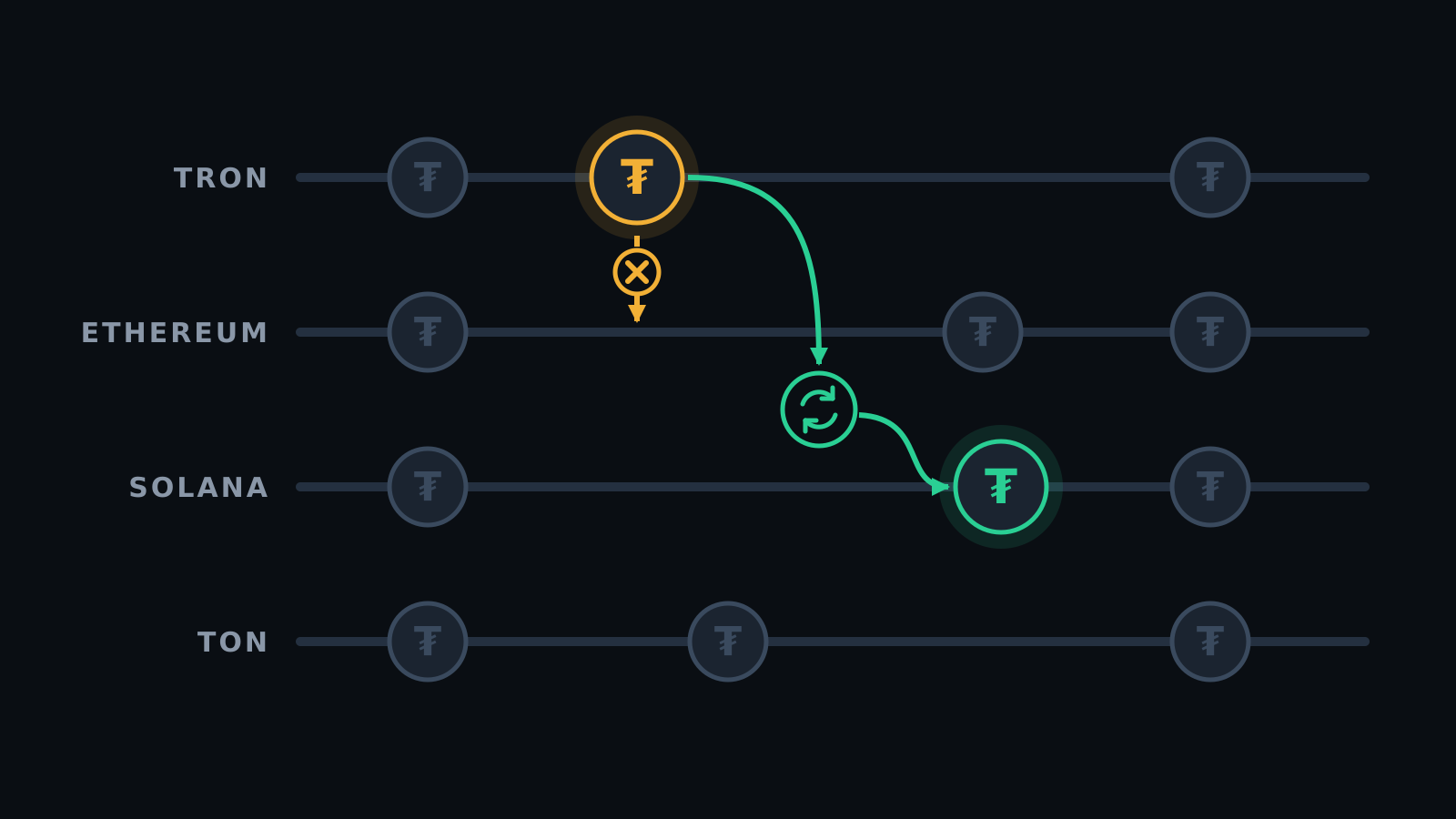
What USDT actually is
USDT is a token issued by Tether. Each unit is meant to be worth one US dollar, and the peg holds because large traders can create and redeem tokens with Tether at exactly $1. When USDT trades below a dollar, buying it on the market and redeeming it with the issuer is profitable, and that buying pulls the price back up.
That redemption window is not open to most people. Tether's own fee page sets the minimum redemption at 100,000 USD, charges the greater of $1,000 or 0.1%, and requires a verified account that costs $150 to open (Tether fees). Someone holding a few hundred dollars in USDT leaves it by selling to someone else, on an exchange or through a swap. They never ask Tether for dollars.
So USDT is closer to a widely accepted IOU than to a dollar in a bank. No deposit insurance stands behind it, and its one-dollar price is a market price. It can slip for a while on a day when many holders want out at the same time.
What backs Tether: the latest numbers
Tether publishes a quarterly attestation. The most recent one was prepared by BDO as of 30 June 2026 and released on 31 July (Tether, Q2 2026):
- about $184.6 billion in USDT issued;
- $187.75 billion in total assets against $183.64 billion in liabilities;
- $4.11 billion in excess reserves, the cushion above what is owed to token holders;
- most of the reserve in US Treasury instruments and repo, plus more than 146 tons of gold.
Two things the headline does not tell you. An attestation confirms a snapshot on one date; it is not a full audit of how the company ran during the quarter. And the cushion is thin relative to the whole: $4.11 billion is a little over 2% of the tokens in circulation. If the assets lost more than that in value, the tokens would no longer be fully covered on paper.
Can USDT be frozen?
Yes, and it is routine. The USDT contracts on Tron and Ethereum include a blacklist. Tether's own wallet can call addBlackList on any address, after which the tokens there cannot move, and destroyBlackFunds burns a frozen balance outright. Tether often mints the same amount again to an address named by a court or by the victims.
The scale, from two sources that count differently:
- Tether says it has frozen more than $4.4 billion in assets since launch, working with more than 340 law enforcement agencies in 65 countries (Tether, 23 April 2026).
- BlockSec's tracker counted 9,597 blacklisted addresses holding $5.69 billion on 26 July 2026: 6,901 addresses and $3.71 billion on Tron, 2,696 addresses and $1.98 billion on Ethereum (BlockSec).
Freezes are aimed at addresses tied to sanctions, hacks and fraud. For an ordinary holder the exposure is indirect: USDT you receive may have passed through a flagged address, or a platform holding your balance may itself get blacklisted. Keeping USDT in a wallet whose seed phrase you control removes the second risk. Nothing removes the first entirely, and that is the trade-off of any issuer-controlled token. We say the same on our XMR to USDT page.
There is also a legal layer. In the EU, the securities regulator ESMA told licensed providers in January 2025 to restrict services for stablecoins not authorised under MiCA (ESMA statement, 17 January 2025), and EU-licensed platforms dropped USDT as a result. Holding it in your own wallet was not banned.
Same ticker, different networks
USDT exists on many blockchains, and each version is a separate token on a separate ledger. By Tether's transparency data on 13 September 2026, Tron carries about $92.7 billion and Ethereum about $86.2 billion. Far behind come Solana with roughly $2.6 billion, TON with about $0.6 billion and Aptos with about $0.57 billion (Tether transparency).
What differs in day-to-day use:
- Tron (TRC-20). Addresses start with
T. The fee is paid in TRX as "energy": about 65,000 energy for a transfer to an address that already holds USDT and about 130,000 to an empty one. Since Tron proposal #104 on 29 August 2025 that works out to roughly 6.5 and 13 TRX burned when you have no staked energy (TronSave). The first transfer to a fresh address costs about twice as much. - Ethereum (ERC-20). Addresses start with
0x. The fee is gas paid in ETH and rises with network load. A wallet holding USDT but no ETH cannot move it at all. - Solana and TON. Fees are paid in SOL or TON and are small, but fewer services accept these versions for deposits.
- Arbitrum, Optimism, Polygon, Avalanche. Cheaper than Ethereum, and they use exactly the same
0x…address format. That is what makes them easy to mix up.
Why a wrong-network transfer goes nowhere
A Tron balance and an Ethereum balance never touch. If you choose Tron while the other side expects Ethereum, the USDT lands on Tron and the recipient's Ethereum wallet shows nothing. Tron and Ethereum addresses look nothing alike, so most wallets reject that mistake before it happens.
The dangerous pairs are Ethereum and its 0x neighbours. An address copied for Ethereum is also valid on Arbitrum or Polygon, the transfer goes through, and the tokens arrive on a chain the recipient may not be watching. If that address belongs to a wallet whose seed phrase you hold, the funds are not lost: add the other network in the same wallet and the balance appears. If it is a deposit address at an exchange, only the exchange can retrieve them, and not every exchange will.
The habit that prevents all of this is simple. Ask which network the receiving side accepts, and send on that one, even if another is cheaper.
How to move USDT from one network to another
There is no button that turns TRC-20 USDT into ERC-20 USDT. Moving between networks always means handing over the token on one chain and receiving the token on the other. A centralized exchange does this through your account: you deposit on Tron and withdraw on Ethereum, and both legs pass through identity verification, as explained in what KYC is and why exchanges ask for it.
On our exchange the same move needs no account. Choose USDT on Tron as what you send and USDT on the network you need as what you get: Ethereum, Solana, TON, Arbitrum, Polygon and several others are available. BNB Smart Chain is not accepted at the time of writing. The order page gives a deposit address on the source network, and the payout goes to the address you entered. Before you send anything, the quote shows the minimum you will receive; our margin is already inside that rate. A refund address on the source network brings the USDT back automatically if the swap cannot be completed.
Two checks before you press the button. Make sure the payout address really belongs to the destination network. For an Ethereum payout, keep a little ETH in that wallet, or the USDT will sit there until you add some.
Can I transfer USDT to my bank account?
Not directly. No blockchain transfer reaches a bank. You need someone who buys USDT for money: a licensed exchange with bank withdrawals, or a person on a peer-to-peer market. We don't do cards or bank transfers; our exchange works only between crypto assets. Wherever fiat leaves a platform, identity checks come with it, which is the other half of the reason crypto exchanges ask for ID.
Is USDT a good investment?
It is not designed to be one. USDT follows a dollar and pays nothing on its own. Any yield offered on it comes from lending it to someone, and that someone's risk comes with the yield. People hold USDT to park value between trades, to send dollars across borders quickly, or to step out of a local currency that is losing value, and for those jobs its known risks are usually acceptable.